

Rat Astrocytes
Worried about losing your cells due to growth or thawing difficulties, or even a random freezer breakdown? Enjoy peace of mind knowing that you can be covered under abm's Cell Line Insurance.
Sale of this item is subjected to the completion of a Material Transfer Agreement (MTA) by the purchasing institution.
For for-profit organizations, please contact quotes@abmgood.com for pricing.
| Cat. No. | T5005 |
| Name | Rat Astrocytes |
| Description |
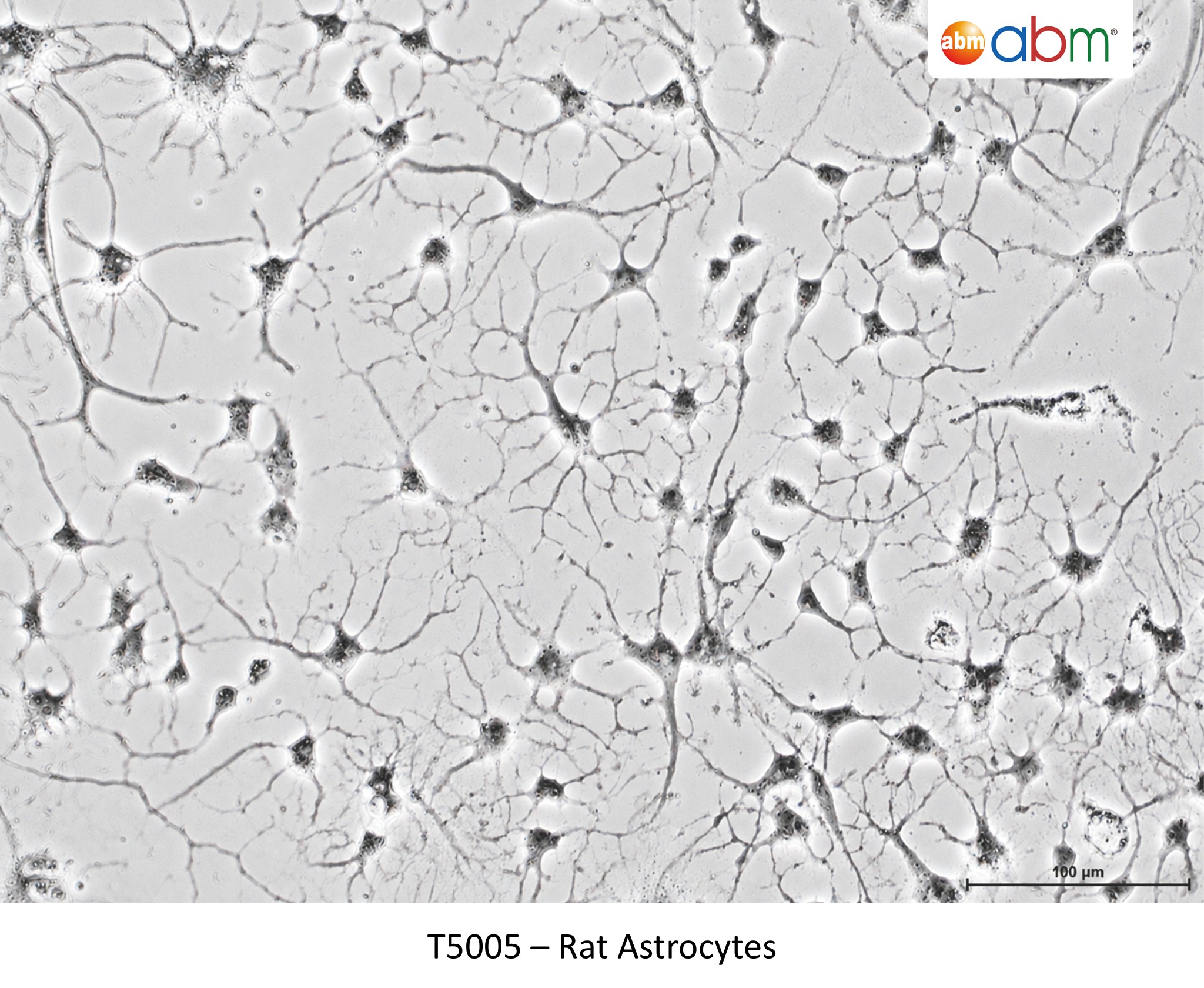
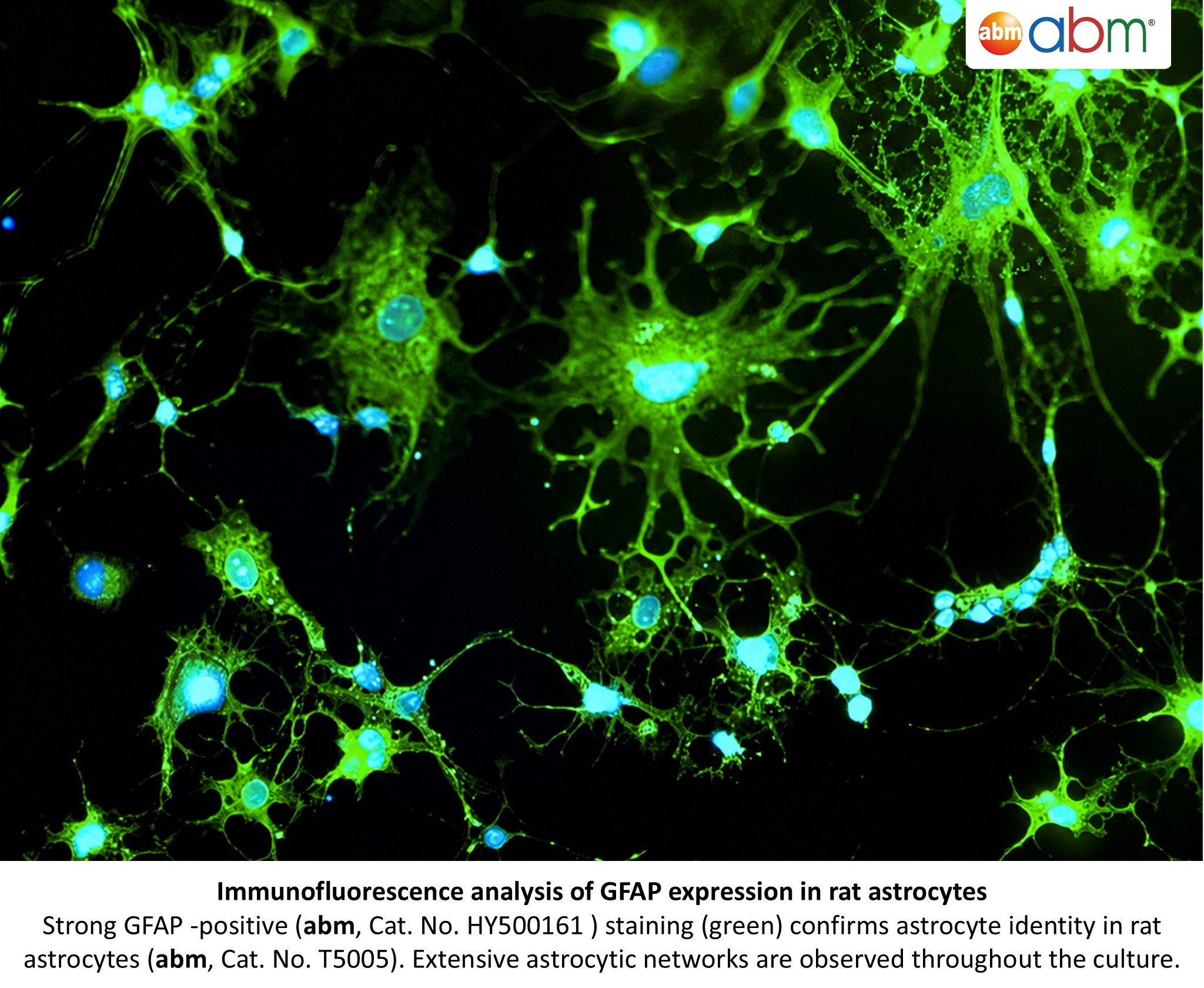
Rat Astrocytes (NSC-derived) are differentiated from well-characterized rat neural stem cells under defined conditions, providing a consistent and reproducible in vitro astrocyte model. These cells exhibit typical morphology and express key markers such as GFAP. Similar to primary cells, these have a finite lifespan in culture. Designed for neurobiology research, these astrocytes are ideal for studying neuron–glia interactions, neuroinflammation, CNS disease models, and drug screening applications. Cells are ready-to-use and can be cultured on standard or PLO/laminin-coated surfaces. Key advantages: • High consistency with reduced variability vs. primary cells • Reproducible and scalable production • Physiologically relevant astrocyte phenotype • Compatible with 2D, co-culture, and 3D systems A reliable and time-saving alternative to primary astrocytes for CNS research. |
| Organism | Rat (R. norvegicus) |
| Tissue | Brain |
| Growth Properties | Adherent, stellate |
| Storage Condition | Vapor phase of liquid nitrogen, or below -130°C. |
| Shipping Conditions | Ship with dry ice. |
| Product Format | Frozen |
| Intended Use | This product is intended for laboratory research use only. It is not intended for any animal or human therapeutic use, any human or animal consumption, or any diagnostic use. |
| BioSafety | II |
| Certificate of Analysis | For batch-specific test results, refer to the applicable certificate of analysis that can be found at www.abmgood.com. |
| Growth Conditions |
For optimal cell culture, we recommend using PriCoat™ T25 Flasks (G299) or coating your preferred vessels with Applied Cell Extracellular Matrix (G422). PriGrow IV (TM004) + 10% FBS (*Regular) + 1% Penicillin/Streptomycin Solution (G255), 37.0°C, 5% CO₂. *Do not heat-inactivate |
| Unpacking and Storage Instructions |
1. Visually examine the packaging containers for signs of leakage or breakage. 2. Immediately transfer frozen cells from dry ice packaging to a temperature below -130°C, preferably in liquid nitrogen vapor phase storage, until ready for use. To ensure the highest level of viability, thaw the vial and initiate culture as soon as possible upon receipt. If continued storage is desired, the vial should only be stored below -130°C or in liquid nitrogen vapor phase. Do not store at -70°C, as it will result in loss of viability. |
| Thawing Protocol |
1. Pre-warm the complete growth medium to 37°C. 2. Prepare the culture vessel by adding appropriate pre-warmed complete growth medium. 3. Remove the cryovial from liquid nitrogen storage and immediately thaw in a 37°C water bath with gentle agitation. Thaw the vial rapidly until only a small ice crystal remains (typically 1–2 minutes). 4. Disinfect the outside of the vial with 70% ethanol before placing it into the biosafety cabinet. 5. Transfer the cell suspension gently into a sterile 15 ml centrifuge tube containing 5–10 ml of pre-warmed complete growth medium. 6. Centrifuge at 125 × g for 5 minutes. 7. Carefully aspirate the supernatant without disturbing the cell pellet. 8. Re-suspend the cell pellet in fresh pre-warmed complete growth medium. 9. Seed the cells into one well of a 6-well plate containing pre-warmed complete growth medium. 10. Incubate the cells at 37°C in a humidified incubator with 5% CO₂. 11. Replace the culture medium after 24 hours to remove residual DMSO and non-adherent cells. 12. Subsequently, refresh the complete growth medium every 2 days. |
| Subculture Protocol |
These are neural stem cell-derived with limited proliferation potential, so a gentle handling procedure is advised.
Volumes given below are for one 6-well plate well. Proportionally increase or decrease the volume as required per culture vessel size. Subculture cells once the culture vessel reaches approximately 80% confluency. 1. Aspirate the culture media and gently rinse the cells once with 1X DPBS, No Ca, No Mg (CH110). 2. Add 1 ml of pre-warmed Gentle Cell Detachment Solution (TM079) to the culture vessel. 3. Observe the cells under a microscope to confirm detachment (typically within 10–20 minutes). Cells that are difficult to detach can be incubated at 37°C for several additional minutes to facilitate detachment. 4. Neutralize the Gentle Cell Detachment Solution (TM079) by adding an equal volume of complete growth media into the culture vessel. 5. Transfer the cell suspension into a sterile centrifuge tube and centrifuge at 125 × g for 5 minutes. The actual centrifuge duration and speed may vary depending on the cell type. 6. Aspirate the supernatant and re-suspend the cell pellet in pre-warmed fresh complete growth media. 7. Seed the cells into new culture vessels at a recommended split ratio of 1:2. 8. Incubate the cells at 37°C in a humidified incubator with 5% CO₂ under recommended culture conditions. 9. The cells may continue to mature morphologically and functionally when maintained in complete growth medium for up to approximately 2 weeks. |
| Split Ratio | 1:2-1:3 |
| Population Doubling Time (h) | 36-72 |
| Warranty | abm warrants that cell lines shall be viable upon initiation of culture for a period of thirty (30) days after shipment and that they shall meet the specifications on the applicable abm Material Product Information sheet, certificate of analysis, and/or catalog description. Such thirty (30) day period is referred to herein as the "Warranty Period”. |
| Disclaimer |
1. All test parameters provided in the CoA are conducted using abm's standardized culture system and procedures. The stated values may vary under the end-user's culture conditions. Please verify that the product is suitable for your studies by referencing published papers or ordering RNA (0.5 μg, Cat.# C207, $450.00) or cell lysate (100 μg, Cat.# C206, $600.00) to perform preliminary experiments, or alternatively use our Gene Expression Assay Service (Cat# C138). All sales are final. 2. We recommend live cell shipments for ease of cell transfer and this option can be requested at the time of ordering. Please note that the end-user will need to evaluate the feasibility of live cell shipment by taking into account the final destination's temperature variation and its geographical location. In addition, we thoroughly test our cell lines for freeze-thaw recovery. If frozen cells were received and not recovered in your lab under the exact, specified conditions (using recommended culture vessel, media, additional supplements, and atmospheric conditions), a live cell replacement is possible at a cost (plus shipping). 3. All of abm's cell biology products are for research use ONLY and NOT for therapeutic/diagnostic applications. abm is not liable for any repercussions arising from the use of its cell biology product(s) in therapeutic/diagnostic application(s). Please contact a technical service representative for more information. 4. abm makes no warranties or representations as to the accuracy of the information on this site. Citations from literature and provided for informational purposes only. abm does not warrant that such information has been shown to be accurate. 5. abm warrants that cell lines shall be viable upon initiation of culture for a period of thirty (30) days after shipment and that they shall meet the specifications on the applicable abm Material Product Information sheet, certificate of analysis, and/or catalog description. Such thirty (30) day period is referred to herein as the "Warranty Period." |
| Application | Research Use Only. |
| Material Citation | If use of this material results in a scientific publication, please cite the material in the following manner: Applied Biological Materials Inc, Cat. No. T5005 |