

DNAfectin™ Plus Transfection Reagent
| Cat. No. | G2500 |
| Name | DNAfectin™ Plus Transfection Reagent |
| Description |
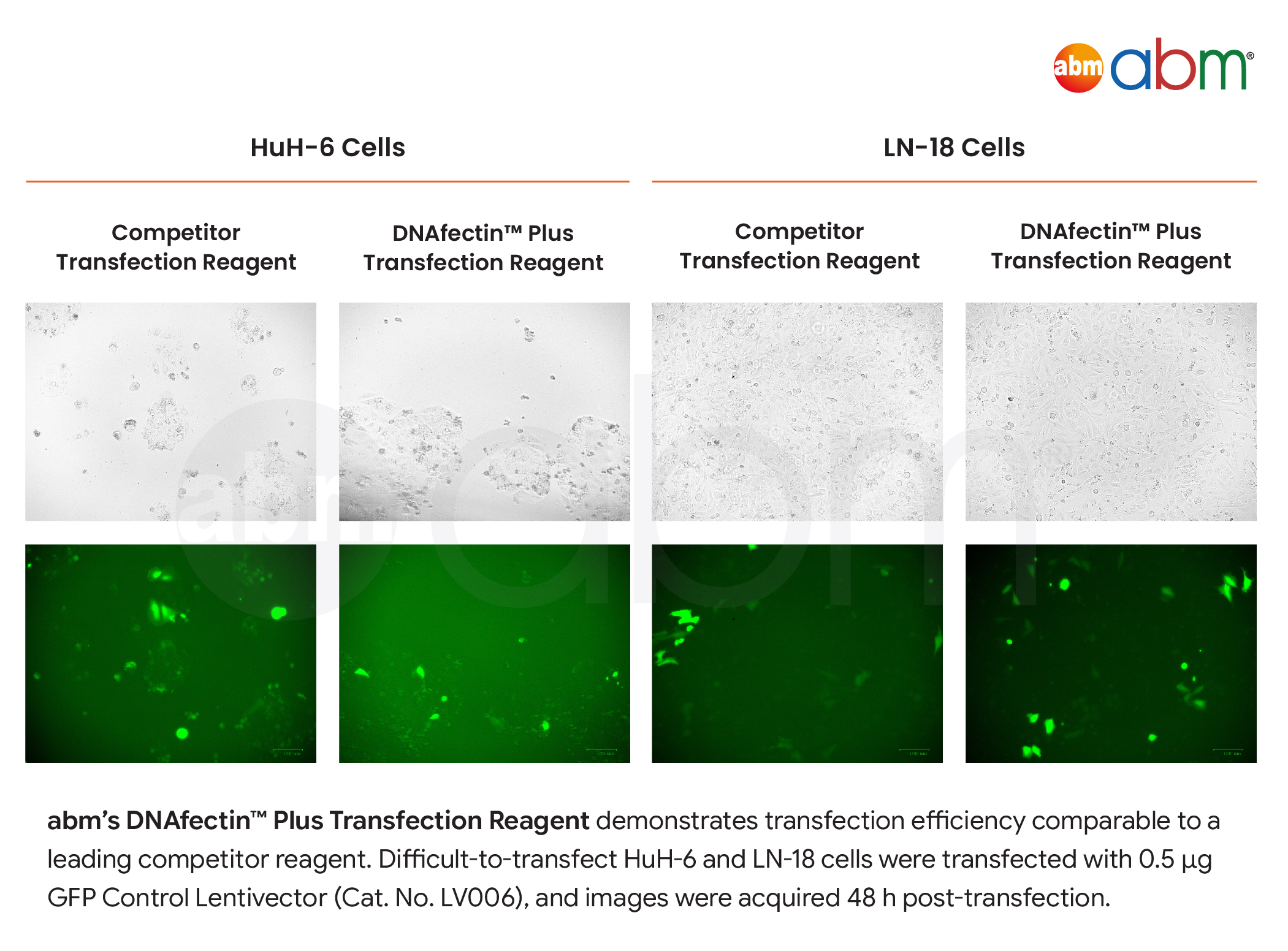
High Transfection Efficiency! abm's DNAfectin™ Plus Transfection Reagent is a unique formulation of polycations and liposomes, which guarantees high transfection efficiency in a wide variety of cell types including primary cells. Product Features:
|
| Unit | 1.0 ml |
| Application |
Transfection of nucleic acids into adherent mammalian cells. |
| Storage Condition |
Store at 4ºC. Do not freeze. |
| Material Citation | If use of this material results in a scientific publication, please cite the material in the following manner: Applied Biological Materials Inc, Cat. No. G2500 |

| What types of cells is DNAfectin™ Plus best suited for? | |
|
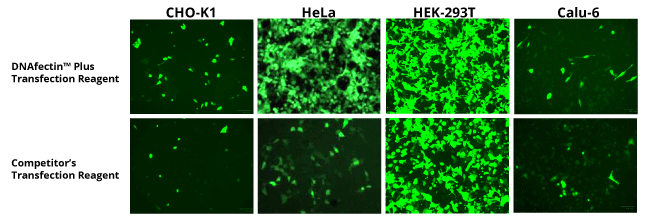
DNAfectin™ Plus is optimized for adherent cells (e.g., HeLa, 293T, COS-7) and is effective in sensitive primary cells, providing high transfection efficiency with low toxicity.
|
| Can I use DNAfectin™ Plus for co-transfection or high-throughput applications? | |
|
Yes. It supports co-transfection of multiple plasmids and is highly reproducible in 96- and 384-well plates, making it ideal for screening and multiplex gene expression experiments.
|
| What makes DNAfectin™ Plus different from other reagents? | |
|
It contains a unique blend of polycations and liposomes, allowing efficient gene delivery and low cytotoxicity, particularly in sensitive or fragile cell types.
|
| Is the reagent compatible with serum-containing media? | |
|
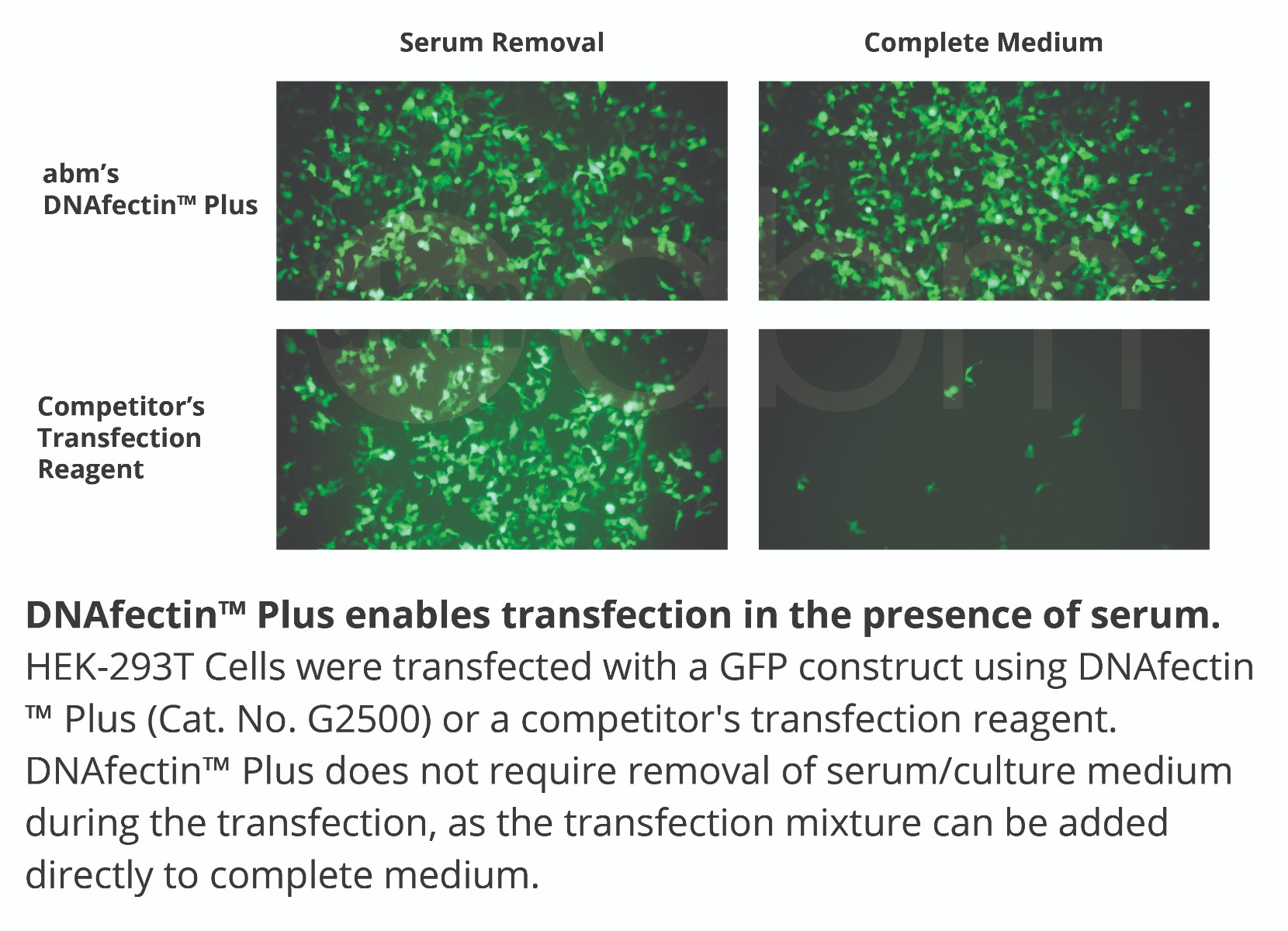
Yes, it works well in complete media with serum, eliminating the need for a media change before or after transfection.
|
| How cytotoxic is this reagent? | |
|
abm's transfection reagents are designed for minimal cytotoxicity. Susfectin™ uses a biodegradable polymer, while DNAfectin™ Plus uses a balanced polycation/liposome formula—both preserve cell health during and after transfection.
|
| How should these reagents be stored? | |
|
Store both reagents at 4 °C. Do not freeze, as freeze–thaw cycles can degrade performance. Aliquoting is recommended for routine use.
|
| What is the general transfection protocol? | |
|
Each reagent is mixed with plasmid DNA to form complexes, then added directly to cells. No media change is required. Specific DNA:reagent ratios and conditions vary and are provided in the respective datasheets.
|
| Is DNAfectin™ Plus Transfection Reagent compatible with lipid nanoparticle technology for delivery of DNA and RNA? | |
|
No, it is not compatible with modern LNP delivery.
|
| I accidentally left my vial of G2500 on the bench at room temperature for several days, is the performance going to be compromised? | |
|
There is no significant change in performance of G2500 stored for up to 10 days at room temperature, so it can withstand temporary storage at room temperature.
|
- Huang, J., Zhou, N., Watabe, K., Lu, Z., Wu, F., Xu, M., & Mo, Y-Y. (2014). Long non-coding RNA UCA1 promotes breast tumor growth by suppression of p27 (Kip1). Cell Death & Disease, 5(1), e1008–e1008. https://doi.org/10.1038/cddis.2013.541
- Singh, R., Pochampally, R., Watabe, K., Lu, Z., & Mo, Y.-Y. (2014). Exosome-mediated transfer of miR-10b promotes cell invasion in breast cancer. Molecular Cancer, 13(1), 256. https://doi.org/10.1186/1476-4598-13-256
- Ott, C. A., Bolormaa Baljinnyam, Zakharov, A. V., Jadhav, A., Simeonov, A., & Zhuang, Z. (2017). Cell Lysate-Based AlphaLISA Deubiquitinase Assay Platform for Identification of Small Molecule Inhibitors. ACS Chemical Biology, 12(9), 2399–2407. https://doi.org/10.1021/acschembio.7b00543
- Ji, Y., Li, L., Ma, Y., Li, W., Li, L., Zhu, H.-Z., Wu, M., & Zhou, J.-R. (2019). Quercetin inhibits growth of hepatocellular carcinoma by apoptosis induction in part via autophagy stimulation in mice. 69, 108–119. https://doi.org/10.1016/j.jnutbio.2019.03.018
- Li, K., Liu, Y., Xu, Z., Zhang, Y., Luo, D., Gao, Y., Qian, Y., Bao, C., Liu, C., Zhang, Y., Qi, X., Cui, H., Wang, Y., Gao, L., & Wang, X. (2019). Avian oncogenic herpesvirus antagonizes the cGAS-STING DNA-sensing pathway to mediate immune evasion. PLOS Pathogens, 15(9), e1007999. https://doi.org/10.1371/journal.ppat.1007999
- Zhang, S., Yang, Y., Huang, S., Deng, C., Zhou, S., Yang, J., Cao, Y., Xu, L., Yuan, Y., Yang, J., Chen, G., Zhou, L., Lv, Y., Wang, L., & Zou, X. (2019). SIRT1 inhibits gastric cancer proliferation and metastasis via STAT3/MMP‐13 signaling. Journal of Cellular Physiology, 234(9), 15395–15406. https://doi.org/10.1002/jcp.28186
-
Ochieng, J., Nangami, G., Sakwe, A., Rana, T., Ingram, S., Goodwin, J. S., Moye, C., Lammers, P., & Adunyah, S. E. (2018). Extracellular histones are the ligands for the uptake of exosomes and hydroxyapatite‐nanoparticles by tumor cells via syndecan‐4. FEBS Letters, 592(19), 3274–3285. https://doi.org/10.1002/1873-3468.13236
-
Huang, Z., Hua, Y., Tian, Y., Qin, C., Qian, J., Bao, M., Liu, Y., Wang, S., Cao, Q., Ju, X., Wang, Z., & Gu, M. (2018). High expression of fructose-bisphosphate aldolase�A induces progression of renal cell carcinoma. Oncology Reports. https://doi.org/10.3892/or.2018.6378
-
Zhu, S., Chen, Z., Wang, L., Peng, D., Belkhiri, A., Lockhart, A. C., & El-Rifai, W. (2018). A Combination of SAHA and Quinacrine Is Effective in Inducing Cancer Cell Death in Upper Gastrointestinal Cancers. Clinical Cancer Research, 24(8), 1905–1916. https://doi.org/10.1158/1078-0432.ccr-17-1716
-
Soyal, S. M., Zara, G., Ferger, B., Felder, T. K., Kwik, M., Nofziger, C., Dossena, S., Schwienbacher, C., Hicks, A. A., Pramstaller, P. P., Paulmichl, M., Weis, S., & Patsch, W. (2019). The PPARGC1A locus and CNS-specific PGC-1α isoforms are associated with Parkinson’s Disease. 121, 34–46. https://doi.org/10.1016/j.nbd.2018.09.016
-
Wei, S., Wang, J., Oyinlade, O., Ma, D., Wang, S., Kratz, L., Lal, B., Xu, Q., Liu, S., Shah, S. R., Zhang, H., Li, Y., Quiñones-Hinojosa, A., Zhu, H., Huang, Z., Cheng, L., Qian, J., & Xia, S. (2018). Heterozygous IDH1R132H/WT created by “single base editing” inhibits human astroglial cell growth by downregulating YAP. Oncogene, 37(38), 5160–5174. https://doi.org/10.1038/s41388-018-0334-9
-
Wang, X., Li, M., Peng, L., & Tang, N. (2020). SOD2 promotes the expression of ABCC2 through lncRNA CLCA3p and improves the detoxification capability of liver cells. Toxicology Letters, 327, 9–18. https://doi.org/10.1016/j.toxlet.2020.03.013
-
Lewicky, J. D., Fraleigh, N. L., Boraman, A., Martel, A. L., Nguyen, T. M.-D. ., Schiller, P. W., Shiao, T. C., Roy, R., Montaut, S., & Le, H.-T. (2020). Mannosylated glycoliposomes for the delivery of a peptide kappa opioid receptor antagonist to the brain. European Journal of Pharmaceutics and Biopharmaceutics, 154, 290–296. https://doi.org/10.1016/j.ejpb.2020.07.021
-
Zhou, C., Chen, Z., Peng, C., Chen, C., & Li, H. (2021). Long Noncoding RNA TRIM52-AS1 Sponges miR-514a-5p to Facilitate Hepatocellular Carcinoma Progression Through Increasing MRPS18A. Cancer Biotherapy and Radiopharmaceuticals, 36(2), 211–219. https://doi.org/10.1089/cbr.2019.3271
-
Jia, Y., Zhang, D., Yin, H., Li, H., Du, J., & Bao, H. (2021). Ganoderic Acid A Attenuates LPS-Induced Neuroinflammation in BV2 Microglia by Activating Farnesoid X Receptor. Neurochemical Research, 46(7), 1725–1736. https://doi.org/10.1007/s11064-021-03303-3
-
Peng, W.-X., Koirala, P., Zhou, H., Jiang, J., Zhang, Z., Yang, L., & Mo, Y.-Y. (2021). Lnc-DC promotes estrogen independent growth and tamoxifen resistance in breast cancer. Cell Death & Disease, 12(11). https://doi.org/10.1038/s41419-021-04288-1
-
Kazberuk, A., Chalecka, M., Palka, J., Bielawska, K., & Surazynski, A. (2022). NSAIDs Induce Proline Dehydrogenase/Proline Oxidase-Dependent and Independent Apoptosis in MCF7 Breast Cancer Cells. International Journal of Molecular Sciences, 23(7), 3813. https://doi.org/10.3390/ijms23073813
-
Doleschal, M. N., Miller, J., Jain, S., Zakharov, A. V., Rai, G., Simeonov, A., Baljinnyam, B., & Zhuang, Z. (2024). Cell-Based Covalent-Capture Deubiquitinase Assay for Inhibitor Discovery. ACS Pharmacology & Translational Science, 7(9), 2827–2839. https://doi.org/10.1021/acsptsci.4c00331
-
Domińska, K., Urbanek, K. A., Kowalska, K., Habrowska-Górczyńska, D. E., Kozieł, M. J., Ochędalski, T., & Piastowska-Ciesielska, A. W. (2024). The consequences of manipulating relaxin family peptide receptor 1 (RXFP1) level in ovarian cancer cells. Reproductive Biology, 24(2), 100864. https://doi.org/10.1016/j.repbio.2024.100864
-
Deng, Z., Yuan, J., Ma, B., Zhu, J., Yan, B., Wei, J., Jin, X., Li, J., Zhang, Q., & Ma, B. (2024). Ziyuglycoside II, a triterpene glycoside compound in Sanguisorbae officinalis l. extract, suppresses metastasis in osteosarcoma via CBX4-mediated Wnt/β-catenin signal pathway. Phytomedicine, 132, 155716. https://doi.org/10.1016/j.phymed.2024.155716